
Everyone knows that lying to your team is bad. Only a complete sociopath would argue that lying to your team is a positive, happy activity. But there’s a particular form of lying that many of the most experienced, compassionate, and honorable managers indulge in all the time: overpromising, and in particular overpromising career rewards. When managers are under pressure, and especially when they’re under pressure to retain a high performer, overpromising is one of the most common tools to reach for. The industry is rife with promises that someone will get a promotion, a new role, a large bonus, 5 more days of vacation, or any number of goodies, large or small.
Overpromising Doesn’t Work
Overpromising carries a terrible risk/reward tradeoff. Here’s how it goes down:
- If you promise something positive, your team member will be very happy for roughly the next 1-72 hours. If their happiness was a 5/10, perhaps they’ll bump to an 8/10.
- After those hours, the future promise will begin to revert back to baseline, because that’s just how human psychology works. Most likely they’ll settle somewhere back where they started – let’s call it 5.5
- If the promised reward does indeed come through, they’ll bump up to a 6/10 for a while.
- But if the promised reward doesn’t come through… their happiness will fall to 1/10 and remain there for a long time, which both feels significantly worse and is much harder to recover from. It can take years, and in some cases can permanently impact how they feel (if you were promised a promotion in year 1 and it’s pushed to year 2, it will permanently feel unfairly delayed).
At this point, you have a very serious personnel problem on your hands that is almost certainly much worse than whatever you had at the start.
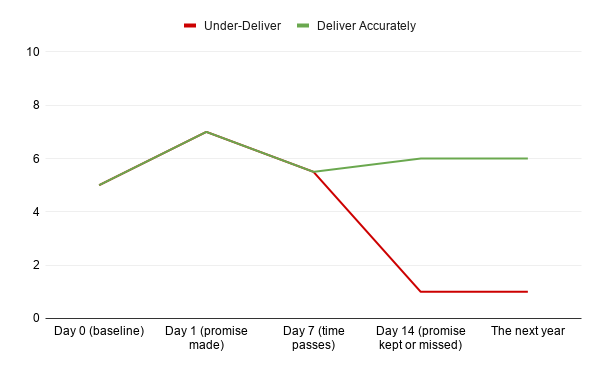 How overpromising actually goes
Decent managers routinely overpromise because if you’re an optimist with a can-do attitude, overpromising doesn’t feel like lying at all. You tell someone “I’m going to get you that promotion,” and you really do want them to get promoted. And you’ll be extra tempted to utter a promise that you can’t quite guarantee because you’re in one of the most stressful situations that a manager can face: a high performer on your team is distressed and upset, and you want to give them the confidence to stay engaged on your team. So you say the words.
But the words are a lie. You often can’t guarantee that you’ll get them promoted. Perhaps you are a department head, and you control all of the budgets and promotion decisions within your group, so you feel confident promising Jeff the promotion to Director. But what if:
- A great new VP is shifted into your group. She’s a star, and everyone likes her, but the reorg that needs to occur (data science moves under her group) means that there’s no need for a Director in Jeff’s role.
- You run a calibration session as many tech companies do, and during that session it comes out that 40% of your team think that Jeff is a real jerk. You noticed some tension, but didn’t realize the extent; he gets great results. But you know the extent now, and you need to wait at least another 6 months for him to work on things.
- The executive team decides that title inflation has gotten out of hand, and promotions are going to be frozen for this cycle while they rebalance. Jeff is a top performer (hence why you wanted to promote him) and as a result he will get a nice equity grant, but not a promotion.
- The company misses numbers and conducts a layoff, and all compensation and title changes are frozen. Sorry Jeff, at least you still have health insurance.
All of these things can and do happen.
Even though overpromising doesn’t feel like lying, it will absolutely be interpreted as lying by your team. Contrast it with a much more mild form of deception: omitting the whole truth, for example by failing to mention that you’re fielding acquisition offers. Despite the fact that this comes from a more deceptive place (you technically really are intending to deceive your team in order to change behavior), people are generally much, much more understanding of merely unrevealed plans. But any untrue statement leaving your mouth, no matter how well-intentioned, runs the potential of causing a huge problem.
The Solution
The solution is simple: Never, ever overpromise. Never let happy promises leave your lips until you are absolutely, 100% certain that you will be able to follow through on them beyond a reasonable doubt.
Of course, you don’t need to run your team like some sort of psychological experiment where you never share anything positive about the future. The way to navigate the landscape feels weird at first, but you should caveat any forward-looking career promises like you’re a paranoid lawyer and/or running down the list of scary-sounding disclosures on a pharmaceutical advertisement. I have literally said “I’m gonna try really hard to do X, but I need to add a disclaimer because I don’t ever want to make a hard promise I can’t keep.”
Here are some common fixes to lines that feel totally normal to say, but run a very real danger of overpromising:
- “I’m going to get you promoted during the next performance cycle” => “I will work with you to put together a promotion packet, and I will advocate hard for your promotion during our calibration session” (Focus on what you can control)
- “We’re going to make you the manager of this new team” => “Assuming that we’re still using the current org structure, my current plan is that you will manage the new team” (Provide accurate disclaimers)
- “I’m going to get you a large equity grant in the next cycle because you’re running short on equity left to vest” => “I fully understand the situation you’re in from an equity vesting perspective, and when we’re issuing grants I am going to do everything that I can to make sure that it’s accounted for” (Skip details that you can’t guarantee)
Avoiding overpromising doesn’t mean that you can’t be sincere with your team. If you feel an emotion, like the fact that someone is really great and you hope they get promoted, it’s usually okay to show it within reason. Emotions that you really feel are authentic by definition, so they don’t run the risk of letting a lie leave your lips.
Takeaways
Your word as a manager is your bond. And if you want to be a good manager you can never break your word, especially to people you manage.
Management is an asymmetric relationship where you hold the power to enable someone to put food on the table, so your word is sacred. It’s better to be honest and painfully disclaim future looking statements than to risk being an optimistic, confident liar. And in the long run your team and your blood pressure will thank you for it.